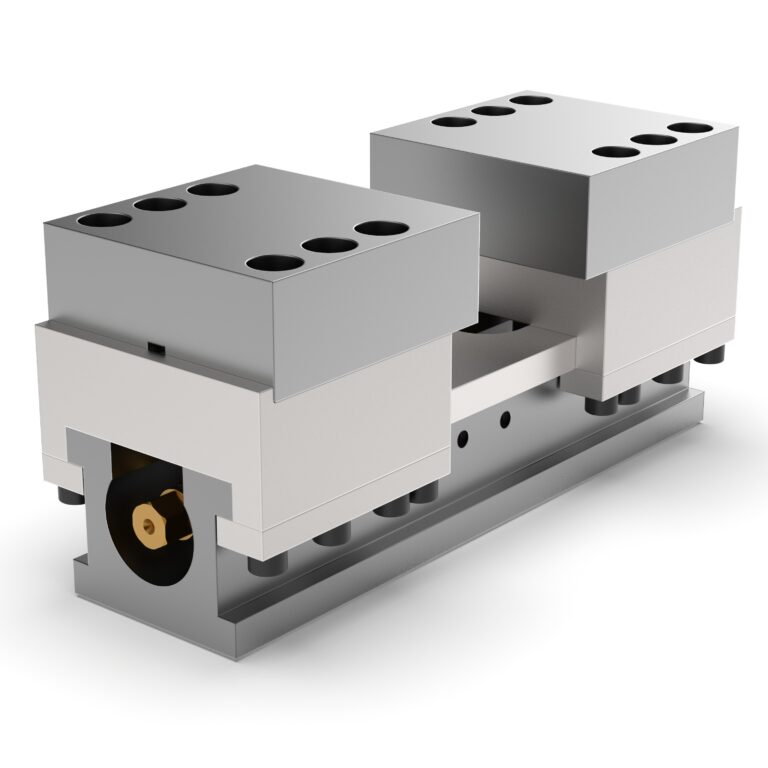




- Mechanical (spindle): high, finely adjustable clamping force, self-contained with no energy supply required — ideal for single parts and small batches.
- Pneumatic (compressed air): fast, consistent clamping force via control signal — ideally suited for automation and series production.
- Hydraulic (hydraulic oil): highest clamping forces in the smallest installation space, held constant — for heavy-duty machining.
- Common to all: both jaws move centrically toward the center — the workpiece center remains fixed in place as the reference.
A self-centering vise clamps a workpiece from two sides simultaneously and symmetrically to the center. Unlike the conventional machine vise, on which only one jaw moves, both jaws are positively synchronized and move toward each other. As a result, the workpiece center remains fixed in place — a decisive advantage for machining with high repeatability. The drive that generates the clamping force determines speed, force, and automation capability. The three common types: mechanical, pneumatic, and hydraulic.
Mechanical self-centering vise
The mechanical self-centering vise generates the clamping force via a spindle with opposing threads that moves both jaws in positive synchronization. The tightening torque allows the clamping force to be adjusted finely and reproducibly. Since no compressed-air or hydraulic connection is required, it is self-contained and can be used anywhere — on the machine, at the measuring station, or as a set-up station solution.
Typical applications: single-part and small-batch production, tool and mold making, 5-axis machining, measuring and inspection tasks.
Pneumatic self-centering vise
In the pneumatic self-centering vise, compressed air handles clamping and unclamping. The air pressure keeps the clamping force consistently reproducible, and clamping takes place in fractions of a second — at the push of a button or via a control signal. This allows the vise to be integrated directly into automated processes and loading cells.
Typical applications: series production, automated loading and unloading, pallet systems, robot cells.
Hydraulic self-centering vise
The hydraulic drive delivers the highest clamping forces in a compact installation space. The hydraulic pressure keeps the clamping force constant — even over long machining times and against high cutting forces. This makes this type ideally suited for heavy-duty machining and wherever maximum process reliability is required.
Typical applications: heavy-duty machining, large workpieces, high metal removal volumes, continuous multi-shift operation.
Self-centering vise drives compared
| Drive | Clamping force | Clamping speed | Automation | Energy supply |
|---|---|---|---|---|
| Mechanical | high, finely adjustable | manual | limited | none |
| Pneumatic | medium, constant | very fast | very good | compressed air |
| Hydraulic | very high, constant | fast | good | hydraulics |
Which self-centering vise suits your application?
The choice depends on the production task: for flexible single-part and small-batch production without a media connection, the mechanical self-centering vise is the robust all-round solution. If you produce larger quantities automatically, the pneumatic drive is the most economical choice. For maximum clamping force in heavy-duty machining, the hydraulic version is the natural choice. In addition, there are electromechanical drives that combine defined force with automation capability.
You can find an overview of all types and sizes on the product page Self-centering vises / centering vises.
Frequently asked questions
What is the difference between a mechanical, a pneumatic, and a hydraulic self-centering vise?
The difference lies in how the clamping force is generated. Mechanical self-centering vises clamp via a spindle — self-contained and finely adjustable. Pneumatic versions use compressed air for fast, consistent clamping in automation. Hydraulic versions generate the highest clamping force in a small installation space for heavy-duty machining.
When does a pneumatic self-centering vise make sense?
Whenever larger quantities of parts are clamped automatically. Compressed air clamps in fractions of a second via a control signal with reproducible force, and the vise can be integrated directly into robot cells, pallet systems, and loading systems.
What repeatability does a self-centering vise achieve?
Thanks to the positively synchronized, centric jaw movement, the workpiece center is maintained as a fixed reference. As a result, self-centering vises achieve high center repeatability — the specific values depend on the type and size.
Is a mechanical self-centering vise suitable for automation?
To a limited extent. Mechanical self-centering vises are designed as a self-contained, flexible solution for single parts and small batches. For automated series production, pneumatic or hydraulic drives are better suited, since they clamp via a control signal.