In brief:
- Machine vise: one fixed jaw — the workpiece center shifts with the width.
- Self-centering vise: both jaws center on a fixed midpoint — reproducible.
- For series production, multiple clamping, and automation, there is hardly any alternative to the self-centering vise.
The difference in principle
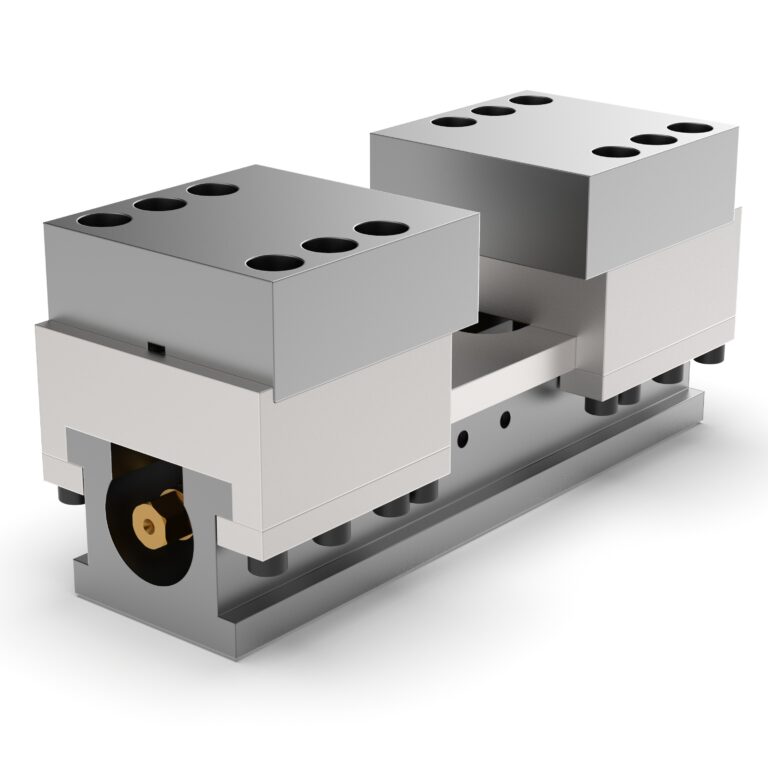
On a conventional machine vise, one jaw is fixed and the other is movable. When workpieces of different widths are clamped, their center shifts. On a self-centering vise, both jaws move synchronously toward a fixed center point — the workpiece center always stays the same.
When is a machine vise sufficient?
For single parts, manual production, and non-critical center positions, the machine vise is robust and inexpensive.
When is a self-centering vise worthwhile?
As soon as repeatability, series production, multi-sided machining, or automation come into play — that is when the fixed center shows its advantage.
Comparison at a glance
| Criterion | Machine vise | Self-centering vise |
|---|---|---|
| Workpiece center | shifts | fixed |
| Repeatability | medium | high |
| Automation capability | limited | yes |
Frequently asked questions
Can a self-centering vise replace a machine vise?
In series and automated production, generally yes. For simple single parts, the machine vise remains an economical option.