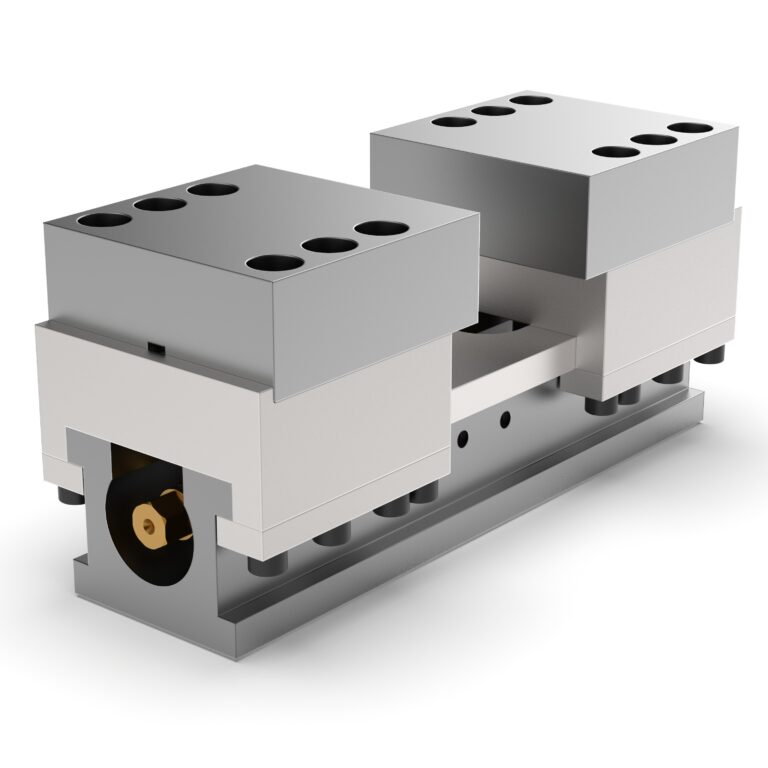




- A self-centering vise clamps the workpiece from two sides and centers it automatically on a fixed center point.
- This ensures high repeatability — ideal for series production and automation.
- Types: mechanical, pneumatic, hydraulic, electromechanical.
What is a self-centering vise?
A self-centering vise (also called a centering vise) clamps a workpiece from both sides simultaneously and symmetrically to the workpiece center. Both jaws move in opposite directions toward a fixed center point — the workpiece center always stays in the same position, regardless of the workpiece width. This is the basis for reproducible machining.
How does a self-centering vise work?
Both jaws are moved synchronously by a central drive:
Mechanical
Clamping via a spindle — robust and independent of any power supply.
Pneumatic & hydraulic
Fast, powerful clamping for series production and automation applications.
Electromechanical
Defined clamping force that can be controlled and monitored — for reliable processes.
Advantages over the conventional machine vise
- Self-centering: constant workpiece center without re-measuring.
- Repeatability: ideal for series production and multiple clamping.
- Automation-ready: can be actuated pneumatically/hydraulically/electromechanically.
Types & selection criteria
The decisive factors are clamping force, clamping range, jaw concept (e.g., interchangeable top jaws), drive type, and required accuracy. For measuring machines and toolmaking, long-term repeatability is what counts.
Frequently asked questions
How does a self-centering vise differ from a machine vise?
On a machine vise, one jaw is fixed; the workpiece center shifts with the width. A self-centering vise centers from both sides on a fixed center — which makes it reproducible.
What is a self-centering vise suitable for?
Wherever a defined center position and repeatability matter: series production, multi-sided machining, automation, metrology.