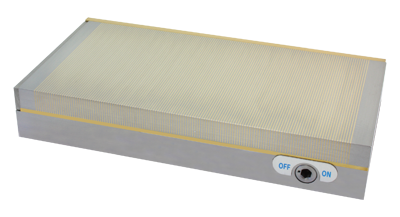




- Magnetic clamping holds ferromagnetic workpieces over their full surface with low distortion.
- Permanent and electro-permanent systems hold even without power.
- All five free sides can be machined in a single set-up.
How does magnetic clamping work?
A magnetic chuck generates a magnetic field that pulls ferromagnetic workpieces onto the support surface over their full area. The holding force is distributed evenly — this reduces point loads and distortion.
Permanent magnet, electro-permanent magnet, or electromagnet?
Permanent magnet
Holds without any energy supply; the holding force is switched on or off mechanically.
Electro-permanent
Is magnetized or demagnetized by a short current pulse and then holds without continuous current — securely, even in the event of a power failure.
Electromagnet
Requires continuous current to provide the holding force.
Advantages of magnetic clamping
- free access from five sides
- uniform holding force over the full surface
- low distortion, fast clamping and release
Requirements
The workpiece must be ferromagnetic and rest flat on the surface. Material thickness and contact area affect the holding force, since the magnetic flux is conducted through the workpiece.
Frequently asked questions
Which materials can be clamped magnetically?
Only ferromagnetic materials such as steel and cast iron. Non-magnetic materials such as aluminum or plastic are better clamped by vacuum.
Does a magnetic chuck lose its holding force in the event of a power failure?
Permanent and electro-permanent systems hold securely even without power. Only pure electromagnets require a continuous power supply.