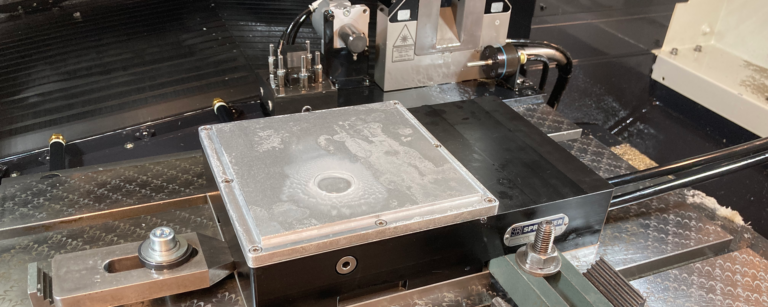




- In freeze clamping, a thin layer of ice holds the workpiece in place by adhesion.
- Ideal for thin, delicate, or sensitive parts that can hardly be clamped mechanically.
- Distortion-free, with a freely accessible machining side.
What is freeze clamping?
In freeze clamping, the workpiece is fixed on a temperature-controlled clamping plate by means of a thin film of water. The film freezes, adheres to the workpiece and the clamping plate, and thus holds the workpiece by adhesion — entirely without mechanical clamping elements.
Operating principle
The clamping plate is cooled down, and a thin film of water between the plate and the workpiece freezes. The layer of ice transmits the necessary holding forces evenly across the entire contact surface.
When is freeze clamping ideal?
Wherever mechanical clamping leads to distortion or damage: thin-walled, delicate, or sensitive workpieces, complex geometries, and parts without suitable clamping surfaces.
Advantages
- distortion-free, uniform holding
- free access to the machining side
- no localized mechanical clamping forces
Frequently asked questions
Which workpieces is freeze clamping suitable for?
Primarily for thin-walled, delicate, or sensitive parts as well as complex geometries that are difficult to clamp mechanically without distortion.
Does the layer of ice provide sufficient clamping forces?
Yes — the holding force is distributed evenly over the entire contact surface and is sufficient for many machining and measuring tasks.