



In brief:
- On coordinate measuring machines, workpieces must be held in a defined, low-distortion, and reproducible manner.
- Modular aluminum clamping systems offer flexible, lightweight configurations for many workpieces.
- This ensures comparable, repeatable measurement results.
Why special clamping fixtures for metrology?
On a coordinate measuring machine (CMM), the way the workpiece is held determines how meaningful the measurement is. The workpiece must be positioned in a defined, low-stress, and reproducible manner — otherwise you measure clamping errors instead of component deviations.
Requirements for measuring fixtures
- Low-distortion: minimal clamping forces, no deformation of the workpiece.
- Reproducible: identical workpiece holding for every measurement.
- Lightweight and stable: modular aluminum kits combine low weight with rigidity.
- Flexible: modular for a wide variety of workpieces.
The modular kit
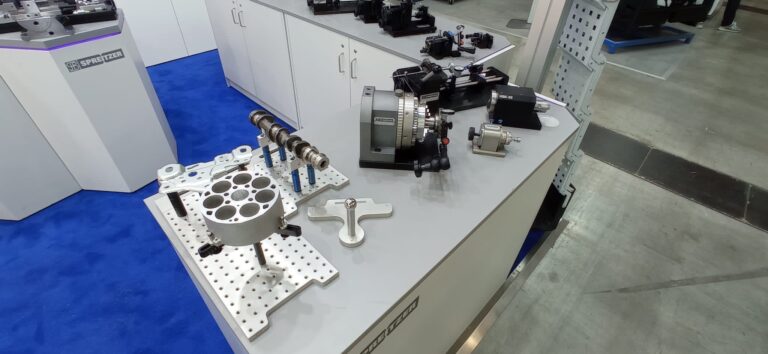
Modular aluminum clamping systems — such as ALUMESS — can be assembled from standard elements for almost any workpiece. This saves fixture costs and makes the measuring process flexible.
Advantages at a glance
- comparable, repeatable measurement results
- low fixture costs thanks to standard modules
- quick changeover to new workpieces
Frequently asked questions
Why do measuring machines require special clamping fixtures?
Because even small clamping forces can deform a workpiece. For meaningful measurements, it must be held reproducibly and with low distortion.
What is the advantage of modular aluminum clamping systems?
They are lightweight, stable, and flexible: fixtures for many workpieces can be built from standard elements — this reduces costs and set-up time.